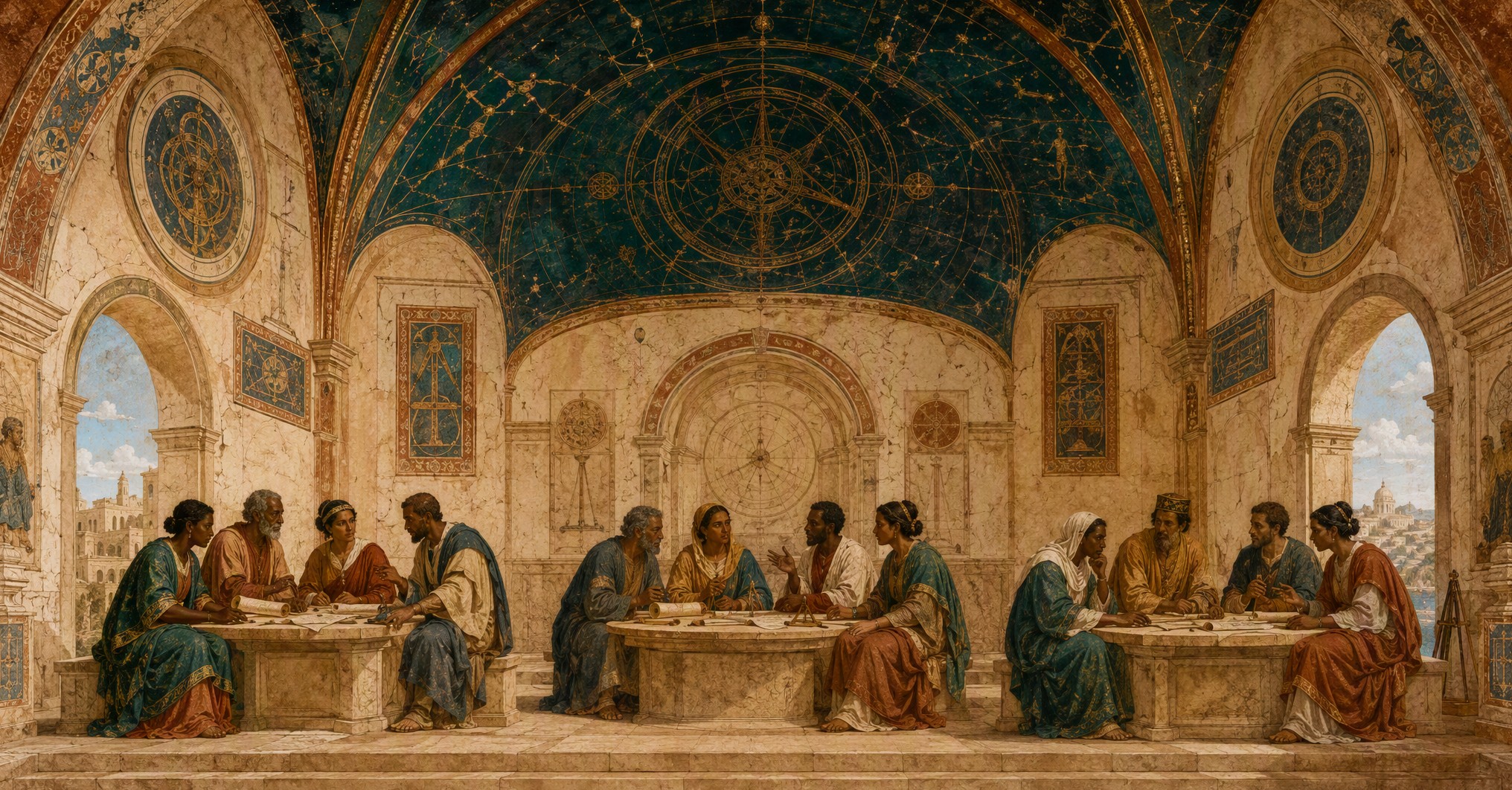
An original fresco of a soaring vaulted council chamber whose teal and copper astronomical vault rises above three small tables of deliberation — men and women of the council in equal counsel, no single leader.
An Alliance for AI Governance

Governance you can actually live inside.

For regulated industries, public institutions, and mission-driven organizations where getting AI wrong carries real consequence.

Fresco Nº 01 — The Assembly Mineral pigment, gold leaf & code on plaster · MMXXVI
Policy Practice People
Plate I — The Idea

Governance on paper governs nothing.
BAM makes it real.

BAM is an alliance that makes AI governance real — defined clearly, built into the systems that enforce it, and understood by the people who use it every day.

Three practices, one discipline: Sekena defines the policy, BTE builds it into the environment, and PangoLabs equips the people who live with it. Not a handoff — an assembly, where each step holds the other two upright.

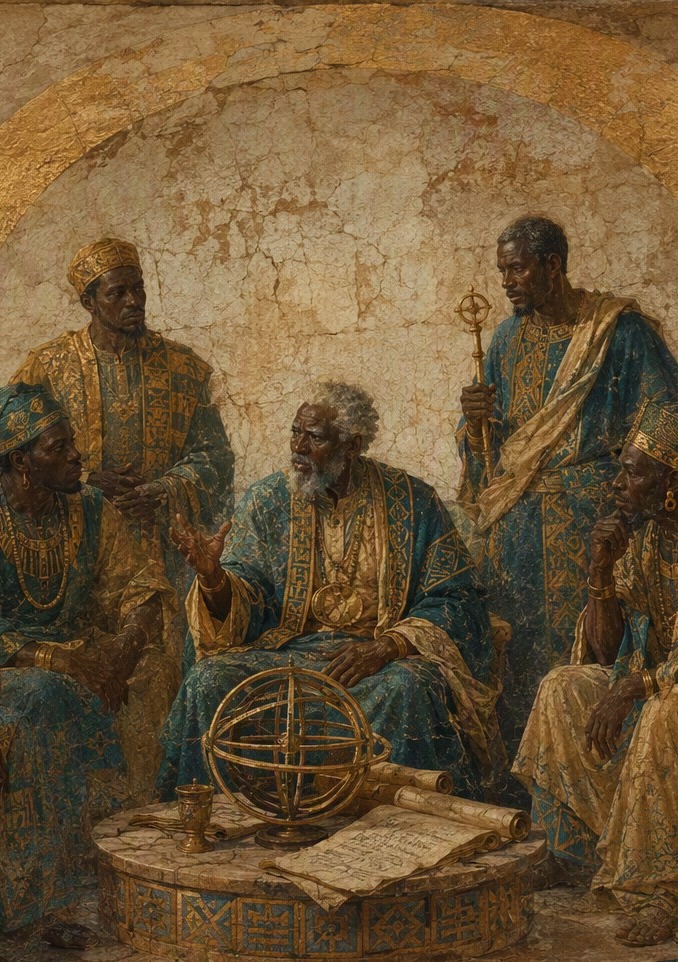
Fresco study of councilors in teal and gold robes deliberating around a stone table bearing an armillary sphere and an open scroll.
Fresco Nº 02 — The CouncilStudy for the Alliance
Plate II — The Approach

Three steps,
in this order.

Each depends on the one before it. Skipping any of them is how governance quietly fails in practice, even when it has succeeded on paper. Every engagement is assembled from the alliance's catalog of offerings — modular, scoped to stand alone or combine.

01 — Define

BAM Delivers Policy

What secure, compliant AI governance actually requires: cybersecurity posture, regulatory alignment, and the board-level clarity that turns technical risk into a decision leadership can act on.

Policy · the first arch
POL-01–04 Governance policy design · regulatory mapping · board briefings · vendor risk review
02 — Build

BAM Turns Policy Into Practice

Policy built into the real environment: working infrastructure, monitoring, and an evidence trail that make governance true in production, not just on paper.

Practice · the second arch
PRA-01–04 Infrastructure implementation · audit-trail design · security hardening · workflow consolidation
03 — Equip

BAM Empowers People

The staff who live with the policy every day, trained and equipped so governance becomes something teams understand and trust rather than something imposed on them.

People · the third arch
PEO-01–03 Literacy training · escalation drills · intake protocol design
Plate III — Why Now

Static governance describes intent.
Kinetic governance produces evidence.

The question regulators now ask is not what you said the system would do — it is what the system is doing right now, and whether that was authorized. Documentation cannot answer it. Only runtime evidence can.

0%
of organizations actively monitor their AI systems — though 75% have usage policies. The rest are running that hospital: intake charts, no monitors.
2025 AI Governance Survey, Pacific AI / Gradient Flow
0%
rise in reported AI incidents in a single year — 233 cases in 2024. Regulators will assess systems daily, not at deployment.
Stanford AI Index, 2025
0 / 5
companies has a mature governance model for autonomous AI agents — the composite systems now selecting tools and executing multi-step workflows.
Deloitte, State of AI in the Enterprise 2026
EU AI Act
Art. 72 post-market monitoring, high-risk systems
Aug 2026 · extraterritorial
Colorado AI Act
Deployer duties, algorithmic discrimination prevention
Jun 30, 2026
FTC — Operation AI Comply
19 enforcement actions in 2024, more than the prior three years combined
Active since Sep 2024
NYDFS Part 500
AI risk assessments & monitoring — no new rule required
Active since Oct 2024
Continuous evidence is becoming the floor, not the ceiling. Sources: BAM Research — From Static Governance to Kinetic Governance, 2026.
BAM Research · Working Paper Nº 01

From Static Governance
to Kinetic Governance

The governance architecture that makes AI trustworthy at scale

A hospital that runs on intake charts alone has yesterday's plan and no record of what the patient's body was doing ten minutes before the crash. Enterprise AI governance in 2026 is that hospital — model cards as intake charts, ethics policies as the physician's plan, and nothing monitoring the runtime.

The shift regulators now demand is kinetic: continuous monitoring that produces auditable evidence of what AI systems did, when, and whether it was authorized. The paper lays out the six-month path — asset register, authorization chains, continuous monitoring, and governance for agentic systems — composed on open standards, not bought as a monolith.

Sayé M. Davies · 2026 · Available on request — ask us for the draft
Plate IV — What BAM Governs

Domains addressed through all three steps —
not bolted on beside them.

Ethics

Fairness with standing, not sentiment
In Policy
What fairness, bias avoidance, and responsible use actually require for this organization — defined in specific, testable terms, not asserted as a value.
In Practice
Bias and fairness checks built into the systems themselves, so ethical review is not a separate meeting bolted onto delivery.
In People
Staff equipped to recognize and escalate a genuine ethical concern, not just told that one exists somewhere in a policy document.

Security

Governance as infrastructure
In Policy
What protecting data, systems, access, and models actually requires, specific to the organization's real exposure — not a generic checklist.
In Practice
Security posture built into the infrastructure itself — governance as infrastructure, applied to security specifically.
In People
Staff trained to recognize a security concern and know the escalation path, the same discipline named for ethics.
Plate V — The Practice

Composed,
not monolithic.

No two organizations carry the same exposure, so nothing here is a fixed package. Every engagement is assembled from the alliance's working catalog — bounded offerings, each scoped to stand alone or combine, organized the way BAM itself is organized.

Policy Practice People
ASSESS-01 · Entry Point — where most engagements startDays, not weeks

AI Governance Readiness Assessment

An inventory of what AI is actually in use or planned across the organization, classified by risk tier and benchmarked against policy coverage, security posture, and staff readiness. A concrete baseline — not a slide deck of generic recommendations.

IncludesUse-case inventory · risk classification · a scored readiness baseline · the highest-priority gaps, ranked

PolicyThe First Arch
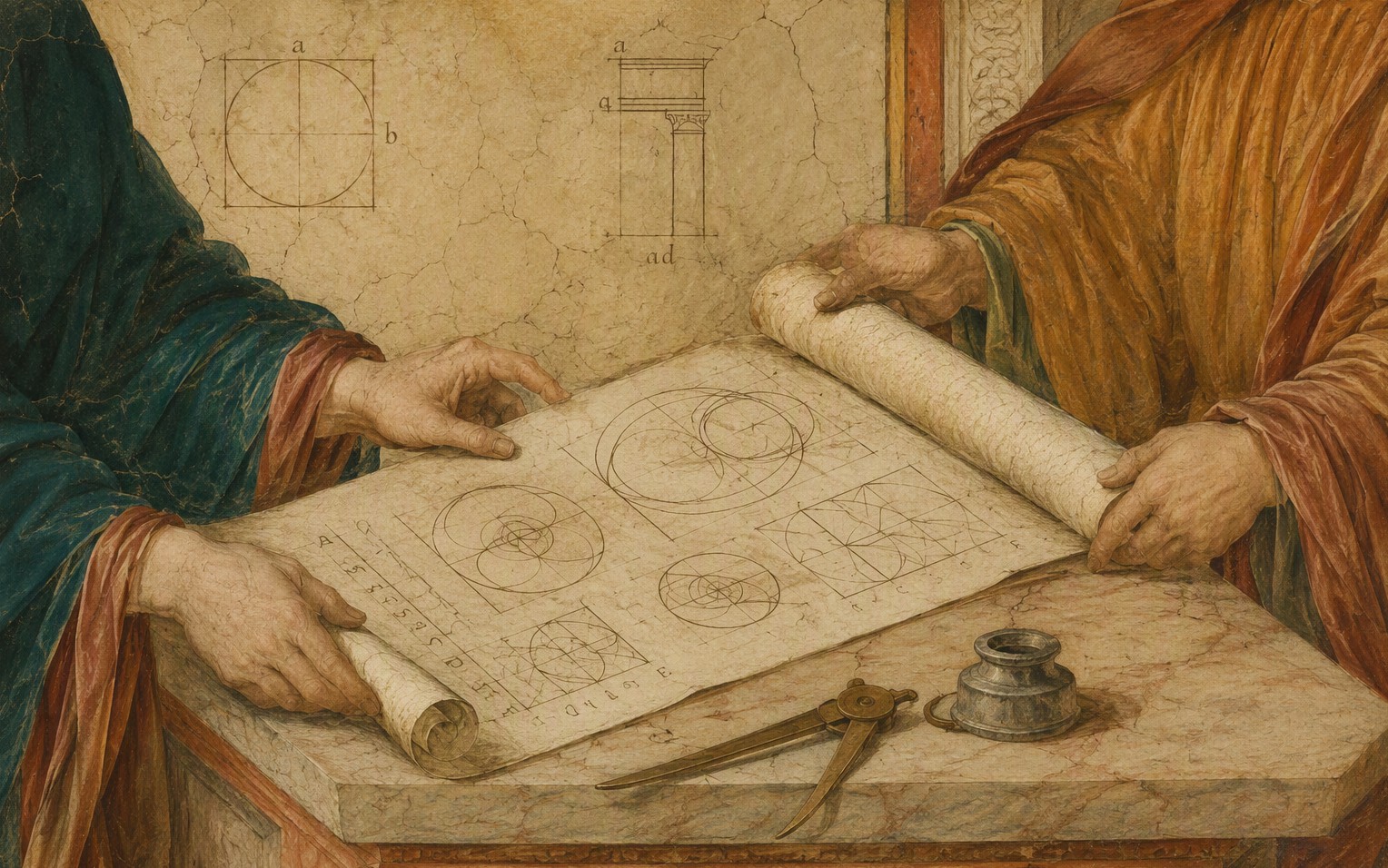
Fresco detail — two pairs of hands unrolling a scroll of geometric diagrams across a stone table, a caliper and inkwell beside it.
Detail Nº 01 — The DraftingScroll · Calipers · Canon
POL-014–8 weeks

AI Governance Policy Design

A framework built for the organization's actual risk profile and regulatory environment — not adapted from a generic template after the fact.

POL-022–3 weeks

Regulatory & Compliance Mapping

The specific obligations that actually apply — sector, jurisdiction, program — tracked continuously, not reviewed once a year.

POL-031–2 weeks

Board & Leadership Briefing

AI risk translated into decision-ready language for the people who have to approve it — or answer for it on a public record.

POL-042–4 weeks

Vendor & Procurement Risk Review

The AI an organization didn't build is still its exposure — screened where that exposure first gets decided: procurement.

PracticeThe Second Arch
Fresco detail — a stonemason's hands setting a chisel-cut keystone into a rising arch, a brass plumb line hanging beside the scaffolding.
Detail Nº 02 — The SettingKeystone · Plumb Line · Scaffold
PRA-016–10 weeks

Governance Infrastructure Implementation

Policy translated into working infrastructure — monitoring, access controls, and approval gates built into the systems themselves.

PRA-023–5 weeks

Evidentiary Readiness & Audit Trail Design

Audit evidence generated as a continuous byproduct of operations — not reconstructed the week an examiner or a records request arrives.

PRA-033–6 weeks

AI System Security Hardening

Protection scoped to real exposure — the data, access, and models a system actually depends on, not a generic checklist.

PRA-042–3 weeks

Workflow Consolidation Review

Duplicate compliance, reporting, and intake processes surfaced and consolidated — the redundant cost this conversation often finds.

PeopleThe Third Arch
Fresco detail — an elder explaining an open tablet to a younger listener who leans in, a stylus resting between them.
Detail Nº 03 — The Handing-OnTablet · Dialogue · Trust
PEO-011–2 weeks

AI Governance Literacy Training

Scaled to actual role and exposure — a frontline user and a policy owner do not need the same session, and this is built to reflect that.

PEO-021 week

Escalation & Incident Response Training

Staff practiced at recognizing a genuine ethical or security concern — and knowing exactly where it goes.

PEO-032 weeks

Change & Intake Protocol Design

How new AI requests actually get evaluated — logged, tiered by impact, and decided deliberately instead of absorbed quietly.

FULL-01 · Ongoing — for organizations that need this held, not delivered onceRetainer, ongoing

Fractional AI Governance Leadership

The full Policy–Practice–People cycle held continuously, for organizations carrying real AI governance exposure without the internal capacity — or the $1.6M — for a full-time executive hire.

IncludesRecurring cadence scoped to the organization's needs · ongoing use-case review · standing access to every offering above

Assembly Examples
How the catalog combines in practice.

Getting Started

First engagement · no existing program
ASSESS-01POL-01PEO-01

Audit & Records Exposure

Public sector · heavily regulated
ASSESS-01PRA-02POL-02PEO-02

Full Program

Held as an ongoing function
ASSESS-01FULL-01

On scope and pricing: Durations describe typical delivery windows, not commitments. Scope is set per engagement, once a readiness assessment or an initial conversation establishes the real starting point. Pricing is scoped individually — nothing here should be read as a quoted rate.

Fresco detail of two hands nearly touching across cracked plaster — one traced in teal and gold patterns, one in warm umber and gold leaf.

The old masters painted councils, not memos. Governance is cut, not smoothed — one deliberate plane at a time.

Plate VI — What BAM Believes

Three convictions
underneath the work.

I

Governance is infrastructure, not paperwork.

A policy that isn't built into the systems it governs is a statement of intent. Real governance is enforced by the environment, not by everyone remembering to follow it.

II

Evidence should be a byproduct, not a project.

If proving compliance requires a scramble, the governance wasn't designed properly. Well-built systems generate their own evidence trail as a matter of course.

III

People are not the last mile.

Training isn't what happens after the real work is finished. Staff who don't understand a policy will route around it, and a system that gets routed around isn't governing anything.

Policy without practice is a document nobody follows. Practice without people is a system nobody trusts. BAM holds all three together.

An alliance of Sekena, BTE & PangoLabs